
 August 16, 2026
 No Comments
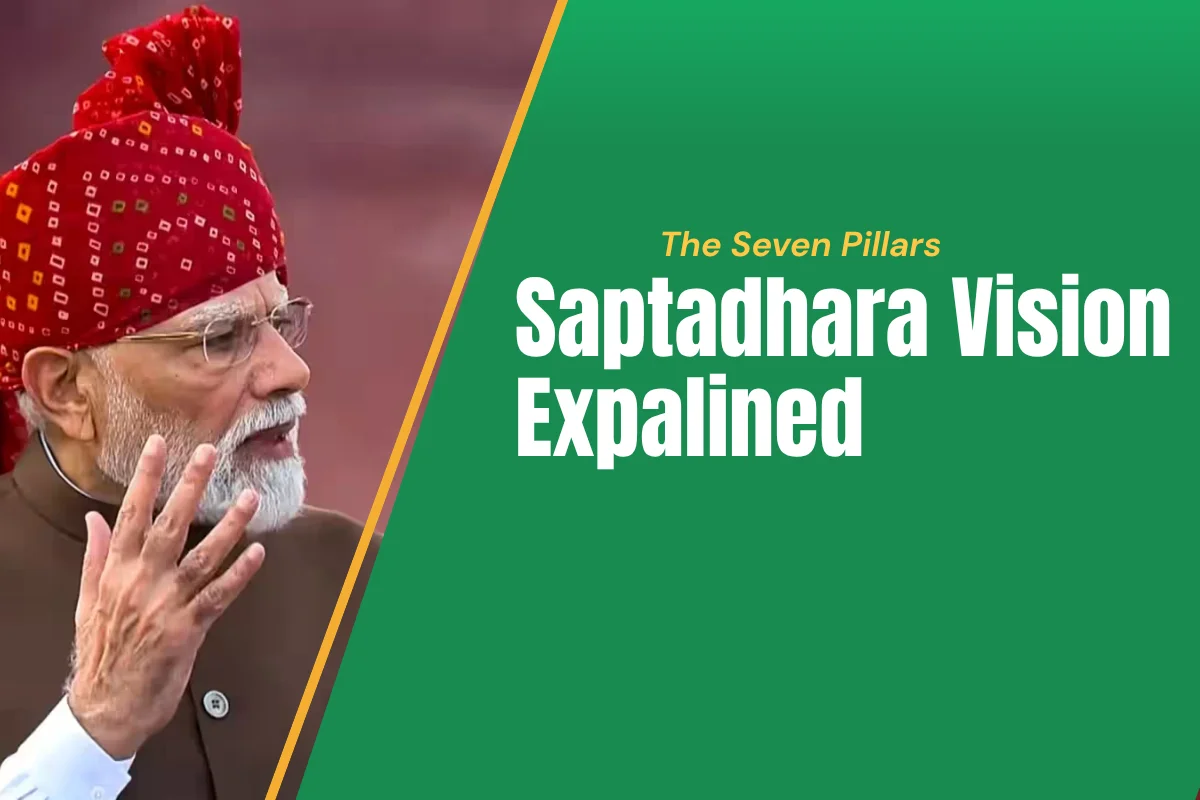
Saptadhara Vision Expalined: The Seven Pillars
Prime Minister Narendra Modi’s 15 August 2026 Independence Day speech from the Red Fort placed a strong emphasis on India’s journey towards Viksit Bharat 2047. One of the most important concepts introduced in the address was “Shakti Ki Saptadhara”, or the seven streams of strength, which the Prime Minister presented as a framework for accelerating India’s development over the coming years.
Drawing an analogy with the ancient idea of Sapta Sindhu, PM Modi said India needs a new set of powerful streams to drive growth, self-reliance, innovation and global leadership. He called for the country to achieve in the next 5–7 years what could not be achieved in the previous 5–7 decades.
For UPSC, IAS, HPAS, PCS and other competitive-exam aspirants, Saptadhara is an important current-affairs topic because it connects Indian Economy, Agriculture, Science & Technology, Infrastructure, Defence, Environment, Blue Economy, Culture and International Relations.
What is Saptadhara?
Saptadhara literally refers to seven streams. In his Independence Day 2026 speech, PM Modi described these as seven major areas that can strengthen India’s capabilities and help achieve the goal of a Viksit Bharat by 2047.
The seven streams are:
- Manufacturing Power
- Agriculture and Food Production
- Technology and Innovation
- Gati Shakti
- Raksha Shakti
- Green Economy and Blue Economy
- India’s Soft Power
The Prime Minister emphasised that these seven streams should not be viewed independently. Their combined strength is intended to create a holistic development model for India.

Why is Saptadhara Important?
India’s development challenge is no longer limited to one sector. A developed economy requires simultaneous progress in:
- Manufacturing
- Agriculture
- Technology
- Infrastructure
- Defence
- Energy and environment
- Culture and global influence
The Saptadhara framework brings these areas together under one broad vision.
PM Modi linked the framework with the larger objective of making India self-reliant, globally competitive and developed by 2047. He also stressed that the government, states, industry, farmers, workers and citizens must work together to achieve this objective.
1. Manufacturing Power
The first stream of Saptadhara is manufacturing power.
PM Modi called for India to substantially increase its manufacturing capabilities and develop the entire value chain—from components and design to finished products.
The objective is not simply to manufacture more products but to make India a trusted hub of global supply chains.
Key focus areas
- Global-standard manufacturing
- Complete domestic value chains
- Component manufacturing
- Product design
- Quality improvement
- Cost competitiveness
- Large-scale production
- MSME participation
- Global exports
The Prime Minister particularly stressed the importance of quality, cost and scale, while calling for zero-defect and precision manufacturing to become India’s identity.
Why it matters
Manufacturing can help India:
- Generate employment
- Increase exports
- Reduce import dependence
- Strengthen MSMEs
- Attract investment
- Build domestic supply chains
- Increase India’s role in global trade
For UPSC, this stream can be linked with Make in India, Atmanirbhar Bharat, PLI schemes, MSMEs and global value chains.
2. Agriculture and Food Production
The second stream is agriculture and food production.
The focus is broader than increasing agricultural output. PM Modi emphasised the need to connect Indian farmers with food processing and global export markets.
He called for moving:
Farm → Processing → Value Addition → Export Market
India has significant potential in products such as:
- Millets
- Spices
- Fruits
- Flowers
- Traditional foods
- Processed agricultural products
The Prime Minister also highlighted the potential of chemical-free farming and meeting global quality standards to expand India’s agricultural exports.
Significance for farmers
A stronger food-processing ecosystem can:
- Increase value addition
- Reduce post-harvest losses
- Improve farmer incomes
- Create rural employment
- Expand agricultural exports
- Build globally recognised Indian food brands
This stream is particularly relevant for UPSC GS Paper III – Agriculture and Food Processing.

3. Technology and Innovation
The third stream of Saptadhara is technology and innovation.
PM Modi highlighted the growing importance of:
- Artificial Intelligence
- Quantum technology
- Space technology
- Robotics
- Data centres
- Semiconductors
- Next-generation communication
- Digital Public Infrastructure
The Prime Minister argued that India should not merely become a market for emerging technologies, but should become a global hub of innovation.
He also highlighted India’s achievements in areas such as UPI and Digital Public Infrastructure and called for Indian digital technologies to reach global markets.
6G ambition
Another important point was the call for Made-in-India 6G technology to reach markets around the world.
This connects Saptadhara with India’s broader ambitions in:
AI + Semiconductors + Quantum Technology + 6G + Space + Digital Infrastructure
For competitive exams, this is an important connection between Science & Technology and Economic Development.
4. Gati Shakti
The fourth stream is Gati Shakti.
Gati Shakti represents the importance of integrated and efficient connectivity for economic growth.
PM Modi emphasised:
- High-speed rail
- Modern highways
- Inland waterways
- Airports
- Multimodal logistics
- Faster connectivity
- Port-led development
The objective is to create a seamless transportation and logistics network that can reduce delays and improve the movement of people and goods.
From infrastructure to economic growth
Infrastructure is not only about physical connectivity. Better logistics can improve:
Production → Transportation → Warehousing → Markets → Exports
This can reduce logistics costs and improve India’s competitiveness in global trade.
The Prime Minister also emphasised that ports should increasingly become centres of port-led development, rather than merely locations for loading and unloading goods.
5. Raksha Shakti
The fifth stream is Raksha Shakti, or defence power.
PM Modi emphasised that India needs greater self-reliance in defence and should move from being a major defence market to becoming a global defence supplier.
Major areas highlighted
- Next-generation defence technology
- Drones
- Counter-drone systems
- Hypersonic defence
- Cybersecurity
- Indigenous defence manufacturing
- Defence exports
The Prime Minister also highlighted the growing importance of cybersecurity and the role of India’s youth in developing capabilities in this field.
Why defence self-reliance matters
A strong domestic defence ecosystem can help India:
- Reduce dependence on imports
- Strengthen strategic autonomy
- Develop advanced technologies
- Generate skilled employment
- Increase defence exports
- Improve national security
For UPSC, this stream can be connected with Defence Indigenisation, Atmanirbhar Bharat, Defence Exports and Emerging Defence Technologies.
6. Green Economy and Blue Economy
The sixth stream of Saptadhara combines the Green Economy and Blue Economy.
This is particularly important because India’s future growth must address both energy requirements and environmental sustainability.
PM Modi highlighted opportunities in:
Green Economy
- Green hydrogen
- Renewable energy
- Energy storage
- Green mobility
- Green manufacturing
Blue Economy
- Fisheries
- Coastal tourism
- Ocean technology
- Marine resources
- Port development
- Coastal economic activities
India’s long coastline provides significant opportunities for the Blue Economy, while its renewable-energy potential creates opportunities for the Green Economy.
Green Jobs
An important dimension of this stream is green employment.
The transition towards cleaner technologies can create new opportunities in:
- Renewable energy
- Electric mobility
- Battery storage
- Green hydrogen
- Sustainable manufacturing
- Marine technology
This makes the sixth stream highly relevant to UPSC Environment, Economy and Geography.
Energy Security as a Key Development Priority
Energy security received significant attention in PM Modi’s Independence Day address.
The Prime Minister highlighted the growing electricity requirements of technologies such as AI, semiconductors and data centres.
He identified nuclear energy as one major component of India’s energy-security strategy and stated a target of 100 GW of nuclear power capacity by 2047. He also referred to a goal of commissioning five new nuclear reactors during the decade and highlighted progress in fast-breeder reactor technology.
The speech also highlighted India’s expansion in solar energy and the PM Surya Ghar Muft Bijli Yojana, including the milestone of 50 lakh households adopting solar systems.
For aspirants, this connects directly with India’s Energy Security, Nuclear Energy, Renewable Energy and Climate Policy.
7. India’s Soft Power
The seventh stream is India’s Soft Power.
PM Modi highlighted India’s ability to influence the world through its:
- Yoga
- Ayurveda
- Culture
- Handicrafts
- Films
- Creative industries
- VFX
- Animation
- Gaming
- Digital content
- Tourism
- Sports
Yoga, for example, has already become an important global symbol associated with India. The Prime Minister argued that India’s cultural and creative strengths can become part of a larger global economic opportunity.
India’s creative economy
The global creative economy provides opportunities for India in:
Films + Animation + Gaming + VFX + Digital Content + Tourism + Sports + Culture
The speech also highlighted the potential of India’s WAVES initiative and the wider audio-visual and entertainment ecosystem.
Saptadhara and Viksit Bharat 2047
The larger objective behind Saptadhara is the vision of Viksit Bharat by 2047, when India completes 100 years of independence.
PM Modi described this as a major national ambition requiring the combined efforts of India’s citizens.
The seven streams can therefore be viewed as an interconnected development framework:
| Saptadhara | Development Objective |
|---|---|
| Manufacturing | Make India a global production hub |
| Agriculture & Food | Connect farms with global markets |
| Technology & Innovation | Make India an innovation hub |
| Gati Shakti | Build fast and integrated connectivity |
| Raksha Shakti | Strengthen defence self-reliance |
| Green & Blue Economy | Combine sustainability with growth |
| Soft Power | Expand India’s global cultural influence |
Together, these seven areas aim to strengthen India’s economic, technological, strategic, environmental and cultural capabilities.
Other Major Highlights of PM Modi’s 15 August 2026 Speech
Although Saptadhara was one of the central themes, the Independence Day address covered several other important issues.
Viksit Bharat 2047
PM Modi reiterated India’s goal of becoming a developed nation by 2047, the centenary year of independence.
Atmanirbhar Bharat
The Prime Minister emphasised self-reliance and highlighted initiatives such as Make in India, Swadeshi and Vocal for Local.
Semiconductor Manufacturing
The speech highlighted India’s semiconductor ambitions, including existing plants and the expectation of additional semiconductor facilities in the coming years.
Critical Minerals
The importance of the National Critical Minerals Mission and securing critical mineral supplies was also highlighted.
Youth and AI
Youth were placed at the centre of India’s technology and development ambitions, particularly in emerging fields such as AI.
Defence and Cybersecurity
The speech stressed defence indigenisation, next-generation technologies, drones, counter-drone systems, hypersonic capabilities and cybersecurity.
Civil Defence
PM Modi announced plans for a more modern and vibrant civil-defence network to prepare citizens for contemporary security and disaster challenges.
Saptadhara: Importance for UPSC and HPAS
For UPSC and HPAS aspirants, Saptadhara is more than a current-affairs headline. It can be used as a framework for analysing India’s development priorities.
UPSC Prelims
Important facts to remember:
- Saptadhara means seven streams of strength.
- It was highlighted by PM Modi during his 15 August 2026 Independence Day address.
- It is linked with the vision of Viksit Bharat 2047.
- Seven streams include manufacturing, agriculture and food production, technology and innovation, Gati Shakti, Raksha Shakti, green and blue economy, and soft power.
- The framework draws an analogy with Sapta Sindhu.
UPSC Mains GS Paper III
Saptadhara can be used in answers related to:
- Indian Economy
- Manufacturing
- Agriculture
- Food Processing
- Science & Technology
- Infrastructure
- Defence
- Energy Security
- Green Economy
- Blue Economy
- Employment
- Atmanirbhar Bharat
Essay Paper
The framework can also be used in essays around:
- Viksit Bharat 2047
- India’s rise as a global power
- Self-reliance and globalisation
- Technology-led development
- Sustainable development
- India’s demographic dividend
- India’s soft power
How to Use Saptadhara in a UPSC Mains Answer
Aspirants can use the seven streams as a ready-made framework for discussing India’s development strategy.
For example:
Introduction:
India’s development journey towards 2047 requires simultaneous progress across economic, technological, strategic, environmental and cultural dimensions.
Body:
Use Saptadhara:
Manufacturing → Agriculture → Technology → Infrastructure → Defence → Green/Blue Economy → Soft Power
Conclusion:
A coordinated approach across these seven streams can help India combine economic growth, strategic autonomy, sustainability and global influence while moving towards Viksit Bharat 2047.
This provides a structured and multidimensional approach to answer writing.
Saptadhara: Key Takeaways
Remember the 7 Streams
1. Manufacturing Power
→ Global manufacturing and supply chains
2. Agriculture & Food Production
→ Food processing, value addition and exports
3. Technology & Innovation
→ AI, quantum, space, robotics, semiconductors and 6G
4. Gati Shakti
→ High-speed connectivity and multimodal infrastructure
5. Raksha Shakti
→ Defence indigenisation and next-generation technologies
6. Green & Blue Economy
→ Renewable energy, green hydrogen, fisheries, coastal tourism and ocean technology
7. Soft Power
→ Yoga, Ayurveda, culture, tourism, films, gaming and creative industries
Conclusion
PM Modi’s Saptadhara vision presented on 15 August 2026 provides a broad framework for India’s development ambitions towards 2047.
The seven streams—Manufacturing, Agriculture & Food Production, Technology & Innovation, Gati Shakti, Raksha Shakti, Green & Blue Economy, and Soft Power—cover many of the critical capabilities required for a modern and globally competitive India.
The larger message is that India’s transformation cannot depend on one sector alone. Manufacturing needs technology, agriculture needs connectivity and exports, defence needs innovation, the green economy needs energy technology, and soft power can strengthen India’s global influence.
For aspirants preparing for UPSC, IAS, HPAS, PCS and other competitive examinations, Saptadhara is therefore an important Current Affairs 2026 topic with direct relevance to both Prelims and Mains.
For structured current-affairs preparation, aspirants can explore the CivilsTap Current Affairs programme, which integrates national and international developments with static GS concepts and exam-oriented preparation for UPSC and State PSC examinations. CivilsTap Current Affairs Course
You can also follow CivilsTap’s Current Affairs updates for regular exam-focused coverage of important national, economic, environmental, science and technology developments. CivilsTap Current Affairs News
Frequently Asked Questions (FAQs)
What is Saptadhara announced by PM Modi?
Saptadhara, or Shakti Ki Saptadhara, is a seven-stream development framework highlighted by PM Modi during his Independence Day speech on 15 August 2026. It focuses on manufacturing, agriculture and food production, technology and innovation, Gati Shakti, Raksha Shakti, green and blue economy, and India’s soft power.
What are the seven pillars of Saptadhara?
The seven streams are Manufacturing Power; Agriculture and Food Production; Technology and Innovation; Gati Shakti; Raksha Shakti; Green and Blue Economy; and Soft Power.
What is the aim of Saptadhara?
The broad aim is to strengthen India’s capabilities across key sectors and support the goal of building a Viksit Bharat by 2047.
When did PM Modi announce Saptadhara?
PM Modi highlighted Shakti Ki Saptadhara in his address from the Red Fort on 15 August 2026, India’s 80th Independence Day.
Why is Saptadhara important for UPSC?
Saptadhara covers several UPSC syllabus areas, including Economy, Agriculture, Science & Technology, Infrastructure, Defence, Environment, Energy, Blue Economy and International Relations. It can be used in both Prelims current-affairs preparation and GS Mains answers.
What is the connection between Saptadhara and Viksit Bharat 2047?
Saptadhara provides seven broad areas of national capability that PM Modi presented as important for achieving India’s ambition of becoming a developed nation by 2047.
Ask your Query
Recent Posts
- HP Allied Services Coaching in Chandigarh 2026 – Online & Offline Classes
- Kishau Multipurpose Project 2026: Key Features, Six-State Agreement and Importance for HPAS
- UPSC Prelims 2026 Paper Analysis: Subject-Wise Difficulty and Lessons for IAS 2027
- UPSC CSAT Preparation Strategy 2027: Complete Study Plan, Syllabus and Tips for Beginners
- Asian Games 2026: Winners & Key Highlights
Browse By Category
- Chandigarh Exam (1)
- Daily Current Affairs (4)
- Defence (1)
- EPFO (9)
- HP Allied (19)
- HP Teaching Exams (4)
- HPAS/HAS (79)
- IAS (90)
- Monthly Current Affairs (1)
- NET Exam (3)
- New Notifications (5)
- PCS (73)
- UPSC (89)
- Weekly Current Affairs (2)
- Yearly Current Affairs (5)

Archives
- October 2026 (9)
- September 2026 (10)
- August 2026 (11)
- July 2026 (13)
- June 2026 (10)
- May 2026 (11)
- April 2026 (10)
- March 2026 (10)
- February 2026 (10)
- January 2026 (9)
- December 2025 (8)
- November 2025 (10)
- October 2025 (10)
- September 2025 (10)
- August 2025 (10)
- July 2025 (6)


Leave Comment