
 August 5, 2026
 No Comments
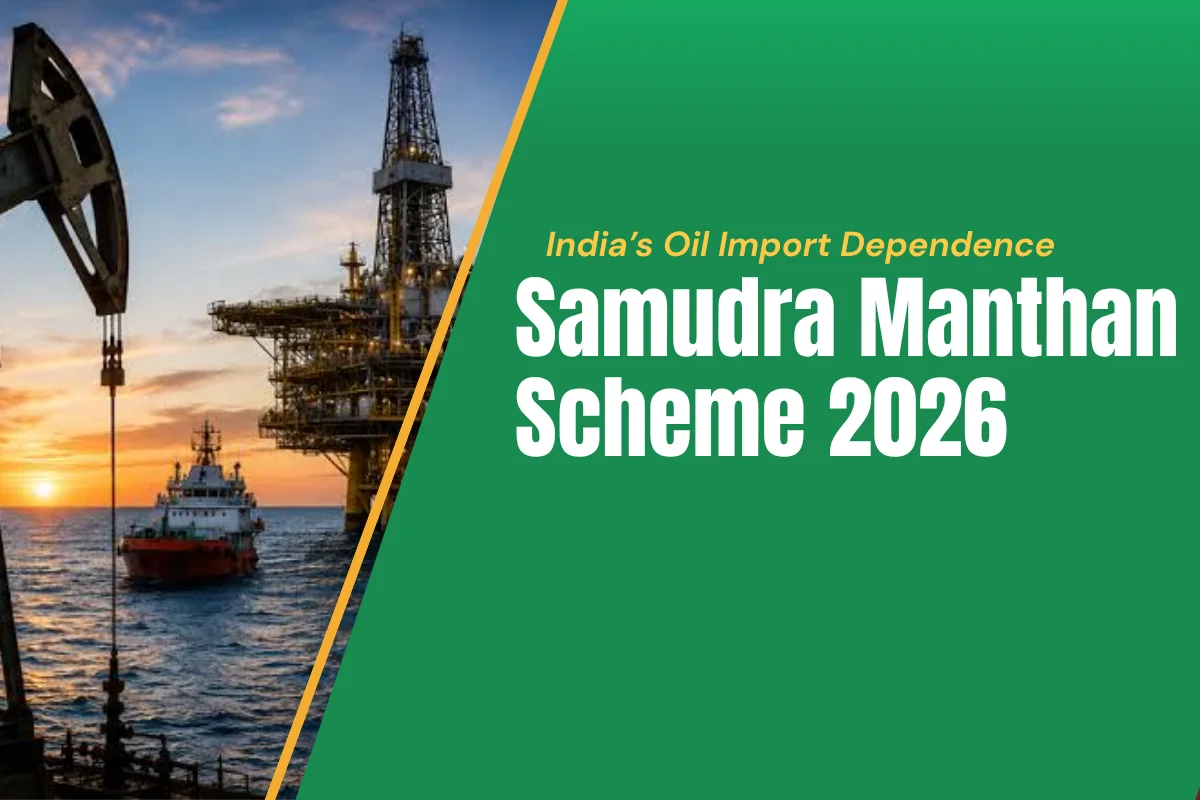
Samudra Manthan Scheme: Reduces India’s Oil Import Dependence
India is one of the world’s largest consumers of crude oil, but a major share of its energy requirement is met through imports. This dependence exposes the Indian economy to fluctuations in international crude prices, geopolitical tensions, supply disruptions and foreign-exchange pressures.
To strengthen India’s long-term energy security and unlock its offshore oil and gas potential, the Union Cabinet has approved ‘Samudra Manthan’ – the National Offshore Exploration Scheme, with an approved outlay of ₹84,084 crore up to FY 2030–31.
For UPSC and other competitive-exam aspirants, the scheme is important from the perspectives of Energy Security, Indian Economy, Blue Economy, Geopolitics, Hydrocarbon Exploration, Atmanirbhar Bharat and Environmental Challenges.
What is the Samudra Manthan Scheme?
Samudra Manthan is a Central Sector Scheme of the Ministry of Petroleum & Natural Gas focused on accelerating exploration and production of oil and natural gas in India’s offshore areas.
The name draws from the idea of Samudra Manthan—extracting valuable resources from the depths of the ocean. In the modern context, India intends to explore its deepwater and ultra-deepwater regions for hydrocarbon resources.
The Union Cabinet approved the scheme on 31 July 2026, with implementation planned through FY 2030–31.
The government describes it as India’s most ambitious offshore exploration mission to date.
Key facts at a glance
| Particular | Details |
|---|---|
| Scheme | Samudra Manthan |
| Official Name | National Offshore Exploration Scheme |
| Ministry | Ministry of Petroleum & Natural Gas |
| Type | Central Sector Scheme |
| Total Outlay | ₹84,084 crore |
| Implementation Period | Up to FY 2030–31 |
| Focus | Offshore oil & gas exploration |
| Major Areas | Deepwater & ultra-deepwater basins |
| Exploration Wells | 60 deepwater exploration wells |
| Government Support | Up to 50% eligible drilling cost or ₹675 crore/well, whichever is lower |
| Expected Resource Addition | More than 600 MMTOE |
| Domestic Production Target | Around 62 MMTOE → 80 MMTOE annually |
The official government release states that the scheme aims to strengthen energy security, accelerate domestic exploration and production, encourage technology development and support the broader vision of Viksit Bharat.
Why Does India Need Samudra Manthan?
India’s economic growth is closely linked with reliable energy availability. However, the country remains heavily dependent on imported crude oil.
According to the Press Information Bureau, India is the world’s third-largest consumer of crude oil, with an annual crude-oil import bill of nearly US$144 billion, or approximately ₹13 lakh crore.
This creates several vulnerabilities.
1. Dependence on international oil prices
When global crude prices rise, India’s import bill can increase significantly. This can put pressure on:
- Inflation
- Current Account Deficit
- Rupee stability
- Transportation costs
- Industrial costs
- Household expenditure
2. Geopolitical risks
Oil-producing regions and major maritime routes are affected by geopolitical developments. Conflicts, sanctions or disruptions in shipping routes can create uncertainty for India’s energy supply.
3. Growing energy demand
As India’s economy expands, demand for transportation, manufacturing, electricity and other forms of energy is expected to increase.
Therefore, simply depending on imports may not be a sustainable long-term strategy.
4. Declining production from existing fields
The government notes that existing oil and gas fields experience a natural production decline of around 6–7% annually. Continuous exploration and new discoveries are therefore necessary to maintain and increase domestic production.
How Will Samudra Manthan Work?
The scheme takes a comprehensive approach rather than simply subsidising oil drilling.
It focuses on four major areas:
1. Offshore Seismic Data – ₹28,534 Crore
Before drilling a well, companies need to understand what lies beneath the seabed.
The scheme therefore provides ₹28,534 crore for acquisition and processing of modern offshore seismic data.
This includes:
- 2D seismic data acquisition: ₹12,000 crore
- 3D seismic data and other techniques: ₹12,534 crore
- National Data Repository re-processing and AI tools: ₹4,000 crore
Better geological and seismic data can help identify promising areas and improve exploration efficiency.
2. Deepwater Exploration – ₹43,200 Crore
The largest component is dedicated to accelerating offshore exploration.
The scheme provides ₹43,200 crore for drilling 60 deepwater exploration wells.
Deepwater exploration is extremely expensive and risky. According to the government, a single deepwater exploratory well can cost approximately US$125–150 million.
To reduce this financial risk, the government will provide support of:
Up to 50% of eligible drilling cost or ₹675 crore per well, whichever is lower.
This risk-sharing mechanism is designed to encourage companies to undertake exploration in technically challenging offshore areas.
3. Common Offshore Infrastructure – ₹10,000 Crore
Discovering oil or gas is only the first step.
After discovery, companies require infrastructure for:
- Production
- Transportation
- Processing
- Evacuation of hydrocarbons
- Connecting offshore fields to onshore facilities
Samudra Manthan therefore allocates ₹10,000 crore for common offshore infrastructure hubs.
The objective is to make commercialisation of discoveries faster and reduce duplication of infrastructure by individual companies.
4. Oil & Gas Manufacturing and Services Zones – ₹2,000 Crore
The fourth major component focuses on building India’s domestic capabilities.
The government has allocated ₹2,000 crore for Oil & Gas Manufacturing and Services Zones.
The objective is to promote:
- Domestic manufacturing
- Localisation of critical equipment
- Offshore technology
- Oil & gas services
- Indigenous supply chains
This connects Samudra Manthan with the broader objectives of Make in India and Atmanirbhar Bharat.
Where Will India Explore?
India’s future offshore hydrocarbon potential is particularly important in deepwater and ultra-deepwater regions.
The government has identified areas including:
- Krishna-Godavari Basin
- Cauvery Basin
- Mahanadi Basin
- Andaman region
The opening up of offshore acreage is another important part of the strategy.
According to the government, more than 99% of previously classified offshore “No-Go” areas have been opened, making more than one million square kilometres of India’s Exclusive Economic Zone (EEZ) available for exploration.
What Does the ₹84,084 Crore Budget Include?
The overall allocation can be understood as follows:
| Component | Allocation |
|---|---|
| Offshore data acquisition | ₹28,534 crore |
| Offshore exploration acceleration | ₹43,200 crore |
| Common offshore infrastructure | ₹10,000 crore |
| Oil & Gas Manufacturing & Services Zones | ₹2,000 crore |
| Monitoring & support activities | ₹350 crore |
| Total | ₹84,084 crore |
The official allocation also includes digital interventions, monitoring, evaluation, human-resource development, awareness and outreach activities.
Can Samudra Manthan Really Reduce India’s Oil Imports?
This is perhaps the most important question.
The answer is potentially yes, but not immediately.
Samudra Manthan is an exploration-led strategy. Finding oil and gas offshore does not automatically mean that production will begin immediately.
Deepwater exploration can take years because it involves:
Survey → Data Analysis → Exploration Drilling → Discovery → Appraisal → Development → Production
The government notes that offshore hydrocarbon projects can typically take 5–10 years from awarding an exploration block to commencement of commercial production.
Therefore, Samudra Manthan should be viewed as a long-term energy-security mission rather than a quick solution to India’s current import dependence.

What Are the Government’s Targets?
Subject to successful exploration, the scheme aims to:
Increase domestic oil & gas production
India’s annual domestic oil and gas production is targeted to rise from approximately:
62 MMTOE → 80 MMTOE
Expand the hydrocarbon resource base
The resource base is targeted to increase from:
1.6 billion TOE → 2.2 billion TOE
Reduce the import bill
According to the government’s assessment, additional domestic production could potentially reduce India’s crude-oil import expenditure by nearly ₹1 lakh crore annually.
The Prime Minister’s Office also states that the scheme is expected to catalyse the addition of more than 600 million metric tonnes of oil equivalent (MMTOE) to India’s hydrocarbon reserves.
Samudra Manthan and India’s Energy Security
Energy security is much broader than simply producing more oil.
For India, it involves:
Reliable supply + diversified sources + domestic production + strategic reserves + infrastructure + renewable energy + technological capability
Samudra Manthan contributes primarily to the domestic production and exploration component.
If successful, increased domestic production could help India:
- Reduce exposure to international crude-price volatility
- Lower the petroleum import bill
- Save foreign exchange
- Improve energy resilience
- Strengthen domestic industries
- Create skilled employment
- Develop offshore technology
- Improve India’s strategic autonomy
Economic Significance of the Scheme
The impact of Samudra Manthan could extend beyond the petroleum sector.
Foreign Exchange Savings
Higher domestic production can reduce the quantity of crude oil that India needs to purchase from abroad.
Employment Generation
Offshore exploration requires expertise in:
- Engineering
- Geology
- Geophysics
- Data science
- Shipping
- Manufacturing
- Construction
- Oilfield services
This can generate both direct and indirect employment.
Manufacturing Growth
Demand for offshore equipment can support domestic manufacturing and localisation.
Technology Development
Deepwater exploration requires advanced seismic imaging, drilling technologies, AI-based interpretation and specialised offshore infrastructure.
This can strengthen India’s technological capabilities.
Environmental Concerns and Challenges
Samudra Manthan also raises important questions.
Deep-sea oil and gas exploration can involve environmental risks, particularly in ecologically sensitive marine areas.
Potential concerns include:
- Oil spills
- Damage to marine ecosystems
- Underwater noise from seismic surveys
- Disturbance to marine biodiversity
- Carbon emissions from fossil-fuel consumption
- Challenges associated with deepwater accidents
Therefore, expansion of offshore hydrocarbon exploration needs to be accompanied by strong environmental safeguards, impact assessments, emergency-response mechanisms and regulatory oversight.
At the same time, India’s long-term energy strategy cannot depend exclusively on hydrocarbons. Domestic oil and gas exploration can improve energy security while India continues its transition towards renewable energy, electric mobility, green hydrogen and other low-carbon technologies.
Major Challenges Before Samudra Manthan
Despite its potential, the scheme faces several challenges.
High exploration risk
Deepwater wells are extremely expensive, and exploration does not guarantee discovery.
Long gestation period
Commercial production may take years after exploration begins.
Technological requirements
Ultra-deepwater exploration requires advanced equipment, specialised expertise and international-level technology.
Environmental sensitivity
Marine ecosystems require careful management during seismic surveys, drilling and production.
Global oil transition
As the world moves towards cleaner energy, investments in new fossil-fuel infrastructure must also consider long-term demand and transition risks.
Samudra Manthan for UPSC: Why Is It Important?
For UPSC Prelims, remember the following facts:
Prelims Quick Revision
- Samudra Manthan = National Offshore Exploration Scheme
- Ministry = Ministry of Petroleum & Natural Gas
- Type = Central Sector Scheme
- Approved outlay = ₹84,084 crore
- Implementation = FY 2030–31
- Focus = Offshore oil and gas exploration
- Deepwater wells = 60
- Drilling allocation = ₹43,200 crore
- Seismic data allocation = ₹28,534 crore
- Common infrastructure = ₹10,000 crore
- Manufacturing & Services Zones = ₹2,000 crore
- Government drilling support = up to 50% of eligible cost or ₹675 crore per well, whichever is lower
- Target domestic production = 62 MMTOE to 80 MMTOE
- Target hydrocarbon resource base = 1.6 billion TOE to 2.2 billion TOE
- Potential annual crude-import savings = nearly ₹1 lakh crore
Samudra Manthan: Mains Perspective
For UPSC Mains GS Paper III, the scheme can be connected with:
Energy Security
Reducing India’s dependence on imported hydrocarbons can improve resilience against global energy shocks.
Blue Economy
India’s offshore resources are an important component of its wider maritime economic potential.
Atmanirbhar Bharat
Domestic production and manufacturing can reduce external dependence.
Geopolitical Security
Diversification of energy sources can reduce India’s vulnerability to disruptions in international supply chains.
Technology
Deepwater exploration can encourage investment in advanced seismic imaging, drilling, AI and offshore engineering.
Sustainable Development
The policy challenge is to balance energy security with India’s climate commitments and ecological concerns.
Conclusion
Samudra Manthan is not simply an oil-drilling scheme; it is an attempt to build a broader offshore energy ecosystem.
With an allocation of ₹84,084 crore, the government is combining seismic data acquisition, deepwater exploration, risk-sharing, common infrastructure and domestic manufacturing to unlock India’s offshore hydrocarbon potential.
The ultimate objective is to increase domestic production, add new hydrocarbon resources and reduce India’s vulnerability to imported energy. However, the results will depend on successful exploration, commercial viability, technological execution and environmental safeguards.
For aspirants, Samudra Manthan is an important example of how energy security, Blue Economy, economic resilience, technology, geopolitics and Atmanirbhar Bharat intersect in India’s development strategy.
In simple terms: India is looking beneath its seas for one part of the answer to its energy-import challenge—while its larger energy future will likely require both domestic hydrocarbons and a faster transition towards cleaner sources.
Frequently Asked Questions (FAQs)
What is Samudra Manthan Scheme?
Samudra Manthan is the National Offshore Exploration Scheme approved by the Union Cabinet to accelerate offshore oil and gas exploration in India.
What is the budget of Samudra Manthan?
The approved outlay is ₹84,084 crore, with implementation through FY 2030–31.
Which ministry implements Samudra Manthan?
It is a Central Sector Scheme of the Ministry of Petroleum & Natural Gas.
How many wells will be drilled under the scheme?
The scheme provides for drilling 60 deepwater exploration wells.
How much can the government support drilling costs?
Government support can be up to 50% of eligible drilling costs or ₹675 crore per well, whichever is lower.
Will Samudra Manthan immediately reduce India’s oil imports?
No. Offshore exploration is a long-term process. The government notes that such projects can take 5–10 years from exploration-block award to commercial production.
Why is Samudra Manthan important for UPSC?
It links Energy Security, Blue Economy, Indian Economy, Geopolitics, Atmanirbhar Bharat, offshore technology and environmental sustainability, making it relevant particularly for UPSC GS Paper III and current affairs.
Tags
Atmanirbhar BharatBlue Economy IndiaCivilstapCurrent Affairs 2026Deepwater ExplorationDeepwater Oil Explorationenergy security IndiaEnergy Security UPSCHydrocarbon ExplorationIndia Energy SecurityIndia Oil ImportsIndian EconomyIndian Energy PolicyMinistry of Petroleum and Natural GasNational Offshore Exploration SchemeOffshore Oil ExplorationOil and Gas in IndiaOil Import DependenceSamudra ManthanSamudra Manthan SchemeUPSC Current AffairsUPSC GS Paper 3upsc preparationViksit Bharat₹84084 Crore SchemeAsk your Query
Recent Posts
- HPAS Mains Answer Writing Strategy: Tips, Format and Examples
- What Should a Good UPSC Foundation Course Include? Complete Checklist for Beginners
- India Energy Week 2027: Key Highlights
- HPAS Coaching in Mandi: Offline vs Online Classes for HAS Aspirants
- How to Use Himachal Pradesh Economic Survey and Budget for HPAS 2027 Preparation
Browse By Category
- Chandigarh Exam (1)
- Daily Current Affairs (4)
- Defence (1)
- EPFO (8)
- HP Allied (19)
- HP Teaching Exams (4)
- HPAS/HAS (77)
- IAS (86)
- Monthly Current Affairs (1)
- NET Exam (3)
- New Notifications (5)
- PCS (71)
- UPSC (85)
- Weekly Current Affairs (2)
- Yearly Current Affairs (5)

Archives
- October 2026 (4)
- September 2026 (10)
- August 2026 (11)
- July 2026 (13)
- June 2026 (10)
- May 2026 (11)
- April 2026 (10)
- March 2026 (10)
- February 2026 (10)
- January 2026 (9)
- December 2025 (8)
- November 2025 (10)
- October 2025 (10)
- September 2025 (10)
- August 2025 (10)
- July 2025 (6)


Leave Comment