
 August 22, 2026
 No Comments
MALHAR 2026: Indian Classical Music and Cultural Heritage
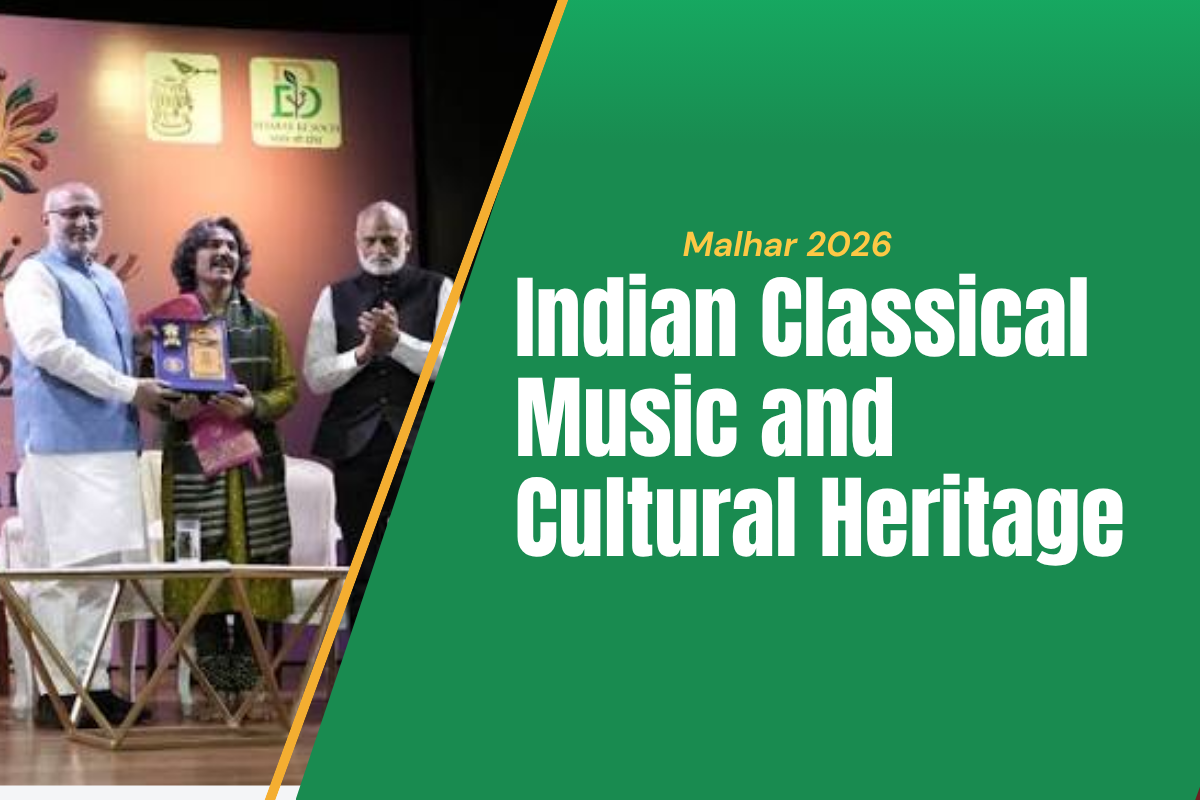
MALHAR 2026 is a youth-centric, monsoon-themed celebration of Indian classical music and cultural heritage organised by Antar Hriday Connect in New Delhi. The event was inaugurated by Vice President of India C. P. Radhakrishnan on 21 August 2026.
For UPSC aspirants, MALHAR 2026 is important from the perspective of Indian Culture, Art & Culture, cultural heritage, youth engagement and current affairs. The event highlights how India’s classical traditions can be preserved while making them accessible and relevant to younger generations.
Explore CivilsTap Current Affairs
What is MALHAR 2026?
MALHAR 2026 is a youth-focused cultural initiative centred on Indian classical music. It uses the monsoon and the musical tradition of the Malhar family of ragas as a theme to connect young audiences with India’s centuries-old musical heritage.
The event was organised by Antar Hriday Connect in New Delhi and featured classical music performances and cultural engagements aimed at making India’s artistic traditions more accessible to the younger generation.
The Vice President appreciated the initiative for creating opportunities for young people to experience and engage with India’s classical music heritage, particularly through free classical music concerts.
MALHAR 2026: Key Facts for UPSC
| Particular | Details |
|---|---|
| Event | MALHAR 2026 |
| Theme | Youth-centric, monsoon-themed celebration of Indian classical music |
| Organised by | Antar Hriday Connect |
| Venue | New Delhi |
| Inaugurated by | Vice President C. P. Radhakrishnan |
| Date of inauguration | 21 August 2026 |
| Focus | Indian classical music, cultural heritage and youth engagement |
| Relevant UPSC areas | Art & Culture, Indian Heritage, Current Affairs |
The event is particularly relevant for UPSC Prelims Current Affairs because questions can be framed around its organiser, purpose, cultural significance and connection with the Malhar tradition.

Why is MALHAR 2026 Important?
1. Promotes Indian Classical Music
India has a rich and diverse classical music tradition consisting primarily of Hindustani and Carnatic music. Events such as MALHAR 2026 provide an avenue for younger audiences to understand and experience this heritage.
The Malhar family of ragas has traditionally been associated with the monsoon season, making it particularly significant in India’s musical and cultural traditions.
2. Connects Youth with Cultural Heritage
One of the major objectives highlighted during MALHAR 2026 was to encourage young people to become custodians and ambassadors of India’s cultural heritage.
For India, cultural continuity depends not only on preserving monuments and traditions but also on ensuring that younger generations understand, practise and value them.
3. Strengthens Cultural Awareness
India’s cultural diversity is reflected through its music, dance, literature, festivals, languages, traditions and performing arts.
MALHAR 2026 demonstrates how cultural programmes can help strengthen awareness of this heritage while creating platforms for contemporary audiences.
4. Makes Classical Music More Accessible
The Vice President particularly appreciated the efforts of Antar Hriday Connect in providing opportunities for young people to engage with classical music, including through free concerts.
This approach can help address one of the challenges faced by traditional art forms: making them accessible to audiences beyond specialist or traditionally trained communities.
What is the Malhar Tradition in Indian Classical Music?
Malhar refers to a family of ragas in Indian classical music traditionally associated with the rainy or monsoon season.
The association between music and seasons is an important feature of Indian musical traditions. Malhar compositions are popularly connected with the imagery and emotions of rain, clouds, coolness and the arrival of the monsoon.
Different variants and related ragas have developed within the Malhar tradition over time.
Some well-known ragas associated with the Malhar family include:
- Miyan Ki Malhar
- Megh Malhar
- Gaud Malhar
- Ramdasi Malhar
- Sur Malhar
For UPSC preparation, aspirants should understand that Malhar is not simply the name of one raga; it refers to a broader family/tradition of ragas associated with the monsoon.
MALHAR 2026 and Indian Cultural Heritage
Indian classical music represents an important component of India’s intangible cultural heritage. Unlike physical heritage such as monuments and archaeological sites, intangible heritage includes traditions, performing arts, knowledge systems and cultural practices transmitted across generations.
MALHAR 2026 is therefore significant because it demonstrates the role of contemporary cultural initiatives in keeping traditional knowledge and artistic practices relevant.
The Vice President emphasised that India’s classical music traditions have survived for centuries because they have evolved while retaining their essence. He also highlighted music’s ability to connect people across regions, languages and cultures.
MALHAR 2026: UPSC Prelims Perspective
From the UPSC Prelims perspective, aspirants should remember the following points:
Important Facts
- MALHAR 2026 was inaugurated in New Delhi.
- It was inaugurated by Vice President C. P. Radhakrishnan.
- The event was organised by Antar Hriday Connect.
- It is a youth-centric celebration of Indian classical music.
- The event has a monsoon theme.
- The Malhar family of ragas is traditionally associated with the monsoon.
- The initiative focuses on connecting youth with India’s classical musical heritage.
- Free classical music concerts were highlighted as an important part of making classical music accessible.
MALHAR 2026: UPSC Mains Perspective
MALHAR 2026 can also be used in UPSC Mains GS Paper 1, particularly under Indian Heritage and Culture.
A possible Mains question could be:
“Cultural heritage survives when traditional practices evolve with changing generations. Discuss in the context of initiatives such as MALHAR 2026.”
Points for a Mains Answer
Introduction:
India possesses a diverse cultural heritage that includes classical music, dance, literature, traditional knowledge and performing arts.
Significance:
- Promotes intergenerational transmission of cultural traditions.
- Encourages youth participation in heritage preservation.
- Makes classical arts more accessible.
- Strengthens cultural identity and social cohesion.
- Demonstrates how traditional art can adapt to contemporary audiences.
- Supports India’s broader cultural diplomacy and soft-power potential.
Challenges:
- Declining interest among younger audiences in some traditional art forms.
- Commercialisation of traditional culture.
- Limited accessibility to specialised cultural education.
- Inadequate documentation of traditional knowledge.
- Generational gaps in transmission.
Way Forward:
- Integrate Indian classical arts into educational programmes.
- Encourage youth-focused cultural festivals.
- Digitise performances and traditional knowledge.
- Provide greater support to artists and institutions.
- Use technology and social media to expand cultural outreach.
Conclusion:
Initiatives such as MALHAR 2026 show that cultural preservation does not mean keeping traditions unchanged. It requires preserving their core while finding new ways to connect them with contemporary generations.

MALHAR 2026 and India’s Soft Power
India’s cultural diversity is an important component of its soft power. Indian classical music, yoga, cinema, cuisine, literature and traditional knowledge have created India’s cultural presence across the world.
Cultural initiatives that encourage younger generations to engage with Indian traditions can strengthen this soft-power ecosystem.
Music, in particular, can transcend linguistic and geographical barriers. This makes India’s classical traditions valuable not only for domestic cultural preservation but also for international cultural engagement.
Why Should UPSC Aspirants Study MALHAR 2026?
Current affairs questions are increasingly connected with static portions of the UPSC syllabus.
MALHAR 2026 can help aspirants connect:
Current Affairs → Indian Culture → Classical Music → Intangible Cultural Heritage → Youth → Cultural Diplomacy → Soft Power
This integrated approach is more useful than memorising isolated facts.
For regular preparation, aspirants can follow CivilsTap’s Daily Current Affairs resources and combine them with static preparation for UPSC.
CivilsTap Daily Current Affairs
CivilsTap UPSC Preparation Platform
MALHAR 2026: Frequently Asked Questions
What is MALHAR 2026?
MALHAR 2026 is a youth-centric, monsoon-themed celebration of Indian classical music organised by Antar Hriday Connect in New Delhi.
Who inaugurated MALHAR 2026?
Vice President of India C. P. Radhakrishnan inaugurated MALHAR 2026 on 21 August 2026.
Who organised MALHAR 2026?
MALHAR 2026 was organised by Antar Hriday Connect.
Why is MALHAR 2026 important for UPSC?
It is relevant to UPSC under Indian Heritage and Culture, Art & Culture, Current Affairs, youth engagement and cultural diplomacy.
What is the Malhar family of ragas?
The Malhar family is a group of Indian classical ragas traditionally associated with the monsoon or rainy season.
What is the significance of Malhar in Indian classical music?
Malhar is culturally associated with the monsoon and has inspired musical compositions reflecting the atmosphere, emotions and imagery connected with rainfall.
Conclusion
MALHAR 2026 highlights the continuing relevance of India’s classical music traditions in contemporary society. By bringing young people closer to Indian classical music, the initiative underlines the importance of intergenerational cultural transmission and active heritage preservation.
For UPSC aspirants, MALHAR 2026 is an important example of how a contemporary event can be linked with the static syllabus of Indian Art & Culture. Understanding the event through the broader themes of classical music, intangible heritage, youth participation and cultural soft power can make current affairs preparation more analytical and useful for both Prelims and Mains.
Stay updated with such important national and cultural developments through CivilsTap’s exam-focused current affairs resources.
Tags
Art and Culture UPSCCivilstapCivilsTap BlogCivilsTap Current AffairsCurrent AffairsCurrent Affairs 2026Indian classical music UPSCIndian culture current affairsMalhar 2026 current affairsMalhar 2026 Indian classical musicMALHAR 2026 organiserMALHAR 2026 UPSCMALHAR 2026 Vice PresidentMalhar family of ragasMalhar ragasAsk your Query
Recent Posts
- HP Allied Services Coaching in Chandigarh 2026 – Online & Offline Classes
- Kishau Multipurpose Project 2026: Key Features, Six-State Agreement and Importance for HPAS
- UPSC Prelims 2026 Paper Analysis: Subject-Wise Difficulty and Lessons for IAS 2027
- UPSC CSAT Preparation Strategy 2027: Complete Study Plan, Syllabus and Tips for Beginners
- Asian Games 2026: Winners & Key Highlights
Browse By Category
- Chandigarh Exam (1)
- Daily Current Affairs (4)
- Defence (1)
- EPFO (9)
- HP Allied (19)
- HP Teaching Exams (4)
- HPAS/HAS (79)
- IAS (90)
- Monthly Current Affairs (1)
- NET Exam (3)
- New Notifications (5)
- PCS (73)
- UPSC (89)
- Weekly Current Affairs (2)
- Yearly Current Affairs (5)

Archives
- October 2026 (9)
- September 2026 (10)
- August 2026 (11)
- July 2026 (13)
- June 2026 (10)
- May 2026 (11)
- April 2026 (10)
- March 2026 (10)
- February 2026 (10)
- January 2026 (9)
- December 2025 (8)
- November 2025 (10)
- October 2025 (10)
- September 2025 (10)
- August 2025 (10)
- July 2025 (6)


Leave Comment