
 August 12, 2026
 No Comments
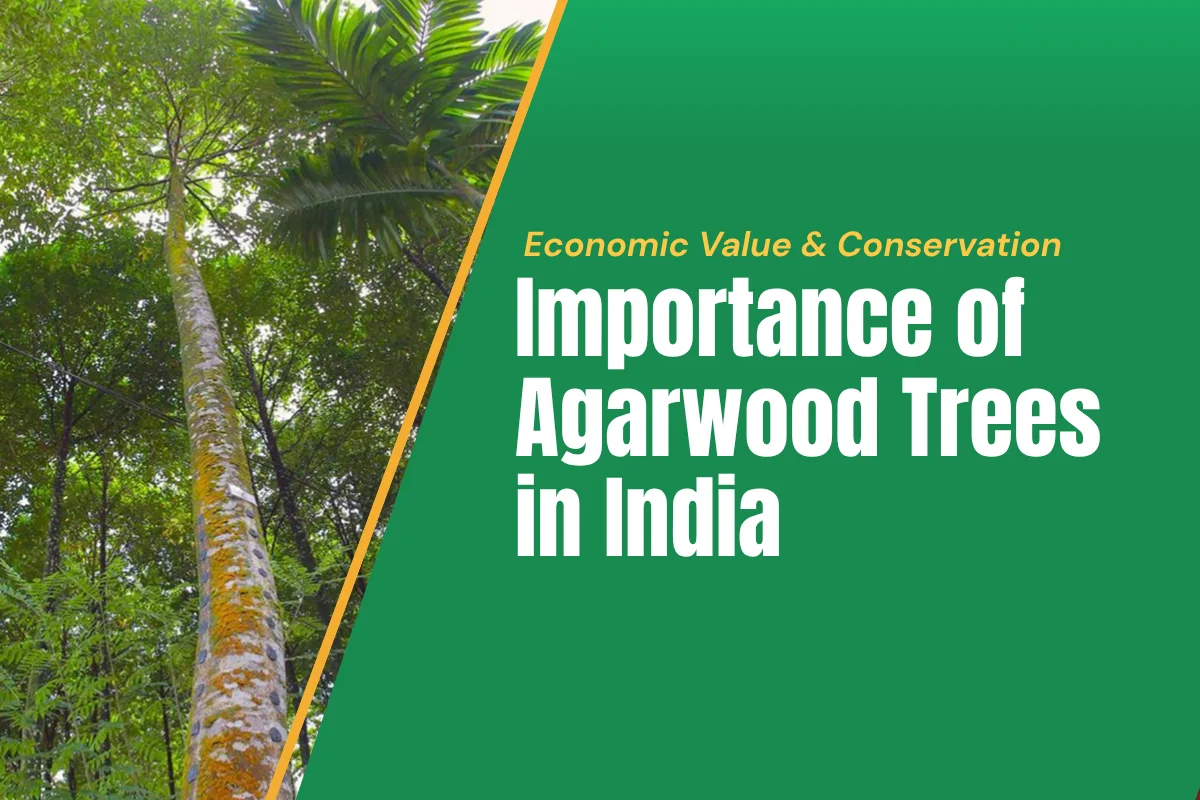
Importance of Agarwood Trees in India
India is home to several economically and ecologically important tree species, and agarwood is among the most valuable. Known as Agar, Oud or Eaglewood, agarwood is obtained primarily from species of the Aquilaria genus, particularly Aquilaria malaccensis in India.
The tree has deep cultural roots in Northeast India and is valued for its fragrant resin, which is used in perfumes, incense, traditional practices, essential oils and other high-value products. Assam and other Northeastern states have traditionally been important centres of agarwood cultivation and processing.
At the same time, agarwood is a significant conservation concern because wild populations of Aquilaria malaccensis have been severely affected by over-exploitation and illegal harvesting. The species is classified as Critically Endangered globally on the IUCN Red List and is listed in CITES Appendix II, making sustainable cultivation and regulated trade particularly important.
For aspirants preparing for UPSC, HPAS, PCS and other competitive examinations, agarwood is an important topic connecting biodiversity, conservation, traditional knowledge, agroforestry, rural livelihoods, international trade and the economy of Northeast India.
What is Agarwood?
Agarwood is a highly aromatic, resin-rich wood associated with trees of the Aquilaria genus.
Interestingly, healthy Aquilaria wood is generally light and does not possess the distinctive fragrance associated with premium agarwood. The valuable resin develops when the tree experiences injury and subsequent microbial infection. In response, the tree produces aromatic resin around the affected tissues.
The resin-impregnated dark wood is then processed into products such as:
- Agarwood chips
- Agarwood powder
- Essential oil
- Perfumes
- Incense
- Fragrant products
- Beads and decorative products
- Traditional medicinal preparations
The leaves are also used in some regions to prepare agarwood tea.

Agarwood Trees in India
India’s most important agarwood species is Aquilaria malaccensis, particularly associated with the Northeastern region.
Wild populations are found mainly in parts of:
- Assam
- Arunachal Pradesh
- Manipur
- Nagaland
- Tripura
Cultivation, however, has expanded beyond its natural distribution. Recent CITES documentation notes cultivated A. malaccensis populations across numerous Indian states, including Assam, Tripura, Kerala, Karnataka and others.
Assam: A Major Agarwood Hub
Assam has a particularly strong association with agarwood. The state government describes Northeast India as an important centre of agarwood aromatics and identifies Assam as the “Agarwood Capital” of India.
Districts such as Golaghat, Jorhat and Sivasagar have significant cultivation and traditional knowledge associated with the tree.
Why is Agarwood So Valuable?
The economic value of agarwood comes primarily from its aromatic resin.
Unlike ordinary timber, premium agarwood is valued for its fragrance and the complex chemical compounds present in its resin.
The quality and value of agarwood can vary depending on factors such as:
- Species
- Geographic origin
- Age of the tree
- Location of resin formation
- Extent of infection
- Resin concentration
- Harvesting methods
- Processing techniques
- Distillation and fermentation
Research and India’s CITES documentation indicate that production of agarwood chips and oil is highly variable and cannot be determined simply by measuring the volume of timber.
This makes agarwood a unique example of a high-value non-timber forest product.
1. Importance of Agarwood in the Perfume Industry
One of the most important uses of agarwood is in the luxury fragrance and perfume industry.
Agarwood oil, commonly associated with oud, is valued for its distinctive and complex fragrance.
It is used in:
- Luxury perfumes
- Attars
- Essential oils
- Fragrance blends
- Incense
- Aromatic products
The international demand for agarwood makes it an important high-value forest and plantation product.
2. Religious and Cultural Importance
Agarwood has been used for centuries in religious and cultural practices.
Its fragrance makes it particularly valuable for:
- Incense
- Religious ceremonies
- Meditation and spiritual practices
- Traditional aromatic preparations
The Government of Assam notes that agarwood has been used for more than 2,000 years for medicinal, aromatic and religious purposes.
This cultural significance has helped preserve traditional knowledge surrounding agarwood cultivation and processing in parts of Northeast India.
3. Traditional Knowledge and Heritage
Agarwood is closely connected with the traditional knowledge systems of Assam and the Northeast.
Traditional cultivation practices include:
- Seed collection
- Nursery preparation
- Plantation management
- Intercropping
- Tree management
- Resin formation techniques
- Harvesting
- Oil extraction
Research conducted in Golaghat district has documented traditional cultivation and management practices used by local communities.
The tree has another fascinating cultural connection: its bark has historically been used in Assam for Sanchipat, a traditional manuscript material.
Thus, agarwood represents the intersection of biodiversity and cultural heritage.
4. Livelihood Opportunities in Northeast India
Agarwood cultivation can provide an additional source of income for farmers and rural communities.
The tree can be cultivated on:
- Private land
- Home gardens
- Community land
- Agroforestry systems
- Production plantations
Studies of upper Assam’s home gardens have shown that agarwood can make a significant contribution to household livelihoods while simultaneously functioning as an on-farm conservation resource.
This makes agarwood important from the perspective of:
Agriculture + Forestry + Rural Economy + Conservation
5. Potential for Agroforestry
Agarwood has potential as an agroforestry crop because it can be incorporated into mixed plantation systems.
The Government of Assam’s Agarwood Promotion Policy highlights the adaptability of agarwood cultivation and its potential to be integrated with other crops.
A well-managed agroforestry model can provide farmers with:
- Diversified income
- Long-term investment
- Tree-based livelihood opportunities
- Better land utilisation
- Conservation benefits
Research has also identified agarwood cultivation as an opportunity for improving farm income and employment, provided that scientific cultivation and proper management practices are adopted.
6. Employment Generation
The agarwood value chain creates employment opportunities beyond cultivation.
It can support activities such as:
Nursery → Plantation → Tree Management → Resin Induction → Harvesting → Processing → Oil Distillation → Packaging → Marketing → Export
This creates opportunities for:
- Farmers
- Nursery operators
- Skilled workers
- Distillation units
- Small businesses
- Artisans
- Traders
- Exporters
Assam’s Agarwood Promotion Policy specifically identifies training local youth in plantation, nursery management, artificial induction, processing and marketing as an important objective.
7. Export Potential
Agarwood has strong international demand, particularly because of its use in luxury fragrances and incense.
However, international trade is subject to conservation-related regulations.
Aquilaria malaccensis is listed in CITES Appendix II, meaning international trade is regulated to ensure that commercial exploitation does not threaten the survival of the species.
India has been working to strengthen sustainable cultivation, processing and regulated trade of agarwood.
According to a January 2026 PIB note, India has nearly 150 million agarwood trees, with around 90% located in the Northeastern states. The same government source notes that export quotas have been strengthened, including limits of 151,080 kg for agarwood chips and 7,050 kg for agarwood oil.
This highlights the growing importance of agarwood as a potential high-value export product from Northeast India.
8. Agarwood and Conservation
Perhaps the most important aspect of agarwood is the need to balance economic utilisation with conservation.
Wild populations of Aquilaria malaccensis have declined because of:
- Over-harvesting
- Illegal felling
- Unregulated trade
- Habitat loss
- Unsustainable extraction
The species is currently considered Critically Endangered globally and is regulated under CITES.
This creates a fundamental policy challenge:
How can India benefit economically from agarwood without damaging its remaining wild populations?
The answer lies in scientific cultivation, sustainable harvesting, traceability and strict regulation of wild populations.
9. Cultivation Can Support Conservation
Agarwood plantations can play an important role in reducing pressure on wild trees.
When farmers grow Aquilaria on private and community land, the resulting supply can come from cultivated sources rather than remaining dependent on wild populations.
CITES documentation notes that India’s current trade in A. malaccensis is based on material harvested from cultivated trees in home and community gardens, private or community plantations and leased-land plantations.
This makes cultivation-based supply chains an important conservation strategy.
10. Role of Science and Technology
Modern science can improve agarwood production while reducing pressure on natural forests.
One major area of research is artificial induction of agarwood formation.
Researchers are studying:
- Microbial induction
- Plant-pathogen interactions
- Resin formation
- Genetic improvement
- Improved planting material
- Oil yield
- Resin quality
- Sustainable harvesting
The Rain Forest Research Institute in Jorhat has undertaken research on genetic improvement and conservation of Aquilaria malaccensis, including the establishment of germplasm resources.
Scientific induction may make cultivation more commercially viable, although resin yield and quality remain variable.
Government Initiatives for Agarwood
The Government of Assam introduced the Agarwood Promotion Policy, 2020, with objectives including:
- Sustainable utilisation
- Promotion of cultivation
- Easier procedures for procurement and processing
- Development of agarwood industries
- Market linkages
- Research and development
- Training of local youth
- Artificial induction techniques
The policy aims to promote agarwood as a sustainable economic resource while ensuring that cultivation and trade remain aligned with conservation requirements.
At the national level, India has also been strengthening the framework for sustainable agarwood cultivation, processing and trade, particularly in the Northeast.
Agarwood and Northeast India’s Economy
Agarwood has the potential to become an important component of the Northeast India’s bioeconomy.
The region already possesses:
- Suitable climatic conditions
- Traditional knowledge
- Existing plantations
- Processing expertise
- Local supply chains
- International market demand
The Government of Assam has described agarwood as having the potential to create another “Green Revolution” in Assam after tea.
If supported by scientific cultivation, processing infrastructure, quality standards and responsible trade, agarwood could contribute to:
Rural Income + Employment + Exports + Conservation + Regional Development

Challenges in Agarwood Cultivation
Despite its potential, the agarwood sector faces several challenges.
1. Threat to Wild Populations
Unscientific harvesting can further reduce natural populations.
2. Variable Resin Formation
Not every tree naturally develops commercially valuable agarwood. Research indicates that natural infection and resin formation can be highly variable.
3. Quality Variation
The quality of agarwood oil depends on several factors, including infection, tree age, harvesting time and processing.
4. Illegal Trade
High market value creates incentives for illegal harvesting and trade.
5. Regulatory Complexity
Because agarwood is a CITES-regulated resource, producers and exporters must comply with applicable conservation and trade regulations.
6. Lack of Standardisation
Improved standards for planting material, resin induction, processing, grading and quality assessment can help the industry become more organised.
Agarwood vs Ordinary Wood: What Makes It Different?
One of the most interesting facts about agarwood is that the valuable product is not simply the tree’s timber.
The commercially valuable material is the resin-rich wood formed in response to injury and microbial infection.
This makes agarwood different from conventional timber crops.
Simple Process
Aquilaria Tree
↓
Injury / Microbial Infection
↓
Tree’s Defence Response
↓
Aromatic Resin Formation
↓
Resin-Rich Agarwood
↓
Chips / Powder / Oil / Perfume / Incense
This biological process is one reason agarwood has such high economic and cultural value.
Agarwood: Important Facts for UPSC Prelims
Quick Revision
| Topic | Key Fact |
|---|---|
| Common name | Agar / Agarwood / Oud / Eaglewood |
| Important Indian species | Aquilaria malaccensis |
| Family | Thymelaeaceae |
| Major region in India | Northeast India |
| Major state | Assam |
| Major products | Chips, powder, oil, perfumes, incense |
| Conservation status | Critically Endangered globally |
| CITES | Appendix II |
| Major economic use | Fragrance and perfume industry |
| Cultural uses | Religious and traditional practices |
| Cultivation model | Home gardens, plantations & agroforestry |
| Major challenge | Over-exploitation and illegal trade |
Agarwood and UPSC Mains
Agarwood can be used in multiple UPSC Mains topics.
GS Paper I – Geography
- Northeast India’s natural resources
- Biodiversity of Northeast India
- Agroforestry
GS Paper II – Governance
- Conservation policies
- Regulation of international wildlife trade
- Sustainable resource management
GS Paper III – Economy
- Rural livelihoods
- Agroforestry
- High-value crops
- Export potential
- Northeast economy
GS Paper III – Environment
- Endangered species
- Biodiversity conservation
- Sustainable harvesting
- CITES
- Ex-situ and on-farm conservation
Essay
Agarwood can illustrate the broader theme:
“Conservation and economic development need not be opposing goals when natural resources are managed sustainably.”
How Can India Make Agarwood More Sustainable?
A sustainable agarwood strategy should focus on five key areas:
1. Promote Cultivation
Increase cultivation on private and community land to reduce pressure on wild populations.
2. Strengthen Traceability
Develop systems to distinguish cultivated material from illegally harvested wild material.
3. Improve Scientific Induction
Research better methods for consistent and high-quality resin formation.
4. Support Local Communities
Provide farmers and local youth with training, technology and market access.
5. Strengthen Conservation
Protect natural populations and prevent illegal harvesting in forests and protected areas.
The objective should be:
“Cultivate more, conserve wild populations, process better and trade responsibly.”
Conclusion
Agarwood trees are important to India not only because of their economic value but also because of their ecological, cultural and livelihood significance.
From the traditional landscapes of Assam to the global luxury fragrance market, agarwood represents a remarkable connection between biodiversity, traditional knowledge and the rural economy.
However, its high value has also contributed to pressure on wild populations. With Aquilaria malaccensis classified as Critically Endangered globally and regulated under CITES Appendix II, India’s future agarwood strategy must prioritise sustainable cultivation and responsible trade.
The growing cultivation base in the Northeast presents an opportunity to turn agarwood into a sustainable high-value agroforestry and export sector, while protecting India’s remaining wild populations.
For UPSC and State PSC aspirants, agarwood is an excellent example of how biodiversity conservation, Northeast development, agroforestry, traditional knowledge, international trade and sustainable development intersect in Indian policy.
Frequently Asked Questions
What is agarwood?
Agarwood is a fragrant, resin-rich wood primarily associated with Aquilaria species. In India, Aquilaria malaccensis is an important agarwood-producing species.
Why is agarwood important in India?
Agarwood is important for its use in perfumes, incense, traditional practices, essential oils and other high-value products. It also provides livelihood and agroforestry opportunities, particularly in Northeast India.
Where is agarwood mainly found in India?
Natural populations are primarily associated with India’s Northeastern region, while cultivated trees are now grown in several other parts of the country.
Why is agarwood expensive?
Its value comes from the aromatic resin that forms inside the tree following injury and microbial infection. The quality and quantity of resin can vary considerably.
Is agarwood endangered?
Aquilaria malaccensis is classified as Critically Endangered globally and is included in CITES Appendix II. Sustainable cultivation and regulated trade are therefore important for its conservation.
What is CITES?
CITES (Convention on International Trade in Endangered Species of Wild Fauna and Flora) is an international agreement that regulates international trade in listed species to ensure that such trade does not threaten their survival.
How can agarwood cultivation help conservation?
Cultivation on private, community and plantation land can provide a sustainable source of agarwood products and reduce dependence on wild populations, provided harvesting and trade are properly regulated.
Ask your Query
Recent Posts
- HP Allied Services Coaching in Chandigarh 2026 – Online & Offline Classes
- Kishau Multipurpose Project 2026: Key Features, Six-State Agreement and Importance for HPAS
- UPSC Prelims 2026 Paper Analysis: Subject-Wise Difficulty and Lessons for IAS 2027
- UPSC CSAT Preparation Strategy 2027: Complete Study Plan, Syllabus and Tips for Beginners
- Asian Games 2026: Winners & Key Highlights
Browse By Category
- Chandigarh Exam (1)
- Daily Current Affairs (4)
- Defence (1)
- EPFO (9)
- HP Allied (19)
- HP Teaching Exams (4)
- HPAS/HAS (79)
- IAS (90)
- Monthly Current Affairs (1)
- NET Exam (3)
- New Notifications (5)
- PCS (73)
- UPSC (89)
- Weekly Current Affairs (2)
- Yearly Current Affairs (5)

Archives
- October 2026 (9)
- September 2026 (10)
- August 2026 (11)
- July 2026 (13)
- June 2026 (10)
- May 2026 (11)
- April 2026 (10)
- March 2026 (10)
- February 2026 (10)
- January 2026 (9)
- December 2025 (8)
- November 2025 (10)
- October 2025 (10)
- September 2025 (10)
- August 2025 (10)
- July 2025 (6)


Leave Comment